
Table of Contents
- What Defines Industrial Style Bar Stool Designs?
- 5 Industrial Style Bar Stool Designs to Know
- Reclaimed Wood Bar Stools: Character That Lasts
- Bar Stool Height Guide: Counter vs. Bar Height
- Custom Industrial Bar Stools for Commercial Spaces
- Safety, Durability, and Weight Capacity
- Conclusion: Find Your Perfect Industrial Stool
- Frequently Asked Questions
Last Updated: September 9, 2026
What Defines Industrial Style Bar Stool Designs?
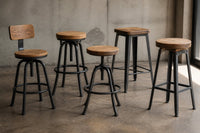
Industrial style bar stool designs blend raw, utilitarian materials like metal and reclaimed wood into a functional aesthetic rooted in early 20th-century factory settings. They pair a sturdy metal frame with a wood or upholstered seat, favoring visible details like rivets, matte finishes, and exposed hardware. What separates true industrial design from a casual rustic look is intent: these pieces look like they could handle a factory shift while anchoring a modern kitchen or bar.
The industrial style bar stool designs we recommend focus on material honesty: cast iron bases, powder-coated steel, and wood that shows its age through patina rather than artificial distressing. At Strong Oaks Woodshop, the frame carries the design, but the seat defines the character. A stool with a worn, character-rich seat becomes a conversation piece.
This category spans everything from minimalist counter stools to heavy-duty commercial seating. The right choice depends on your space, height requirements, and visual weight. Below, we break down the five core design directions that dominate the market.
5 Industrial Style Bar Stool Designs to Know
Most industrial style bar stool designs fall into one of five categories, each suited to a different room layout and use case. What separates a good purchase from a regret is understanding the mechanics and ergonomics behind each style, not just the look.
Classic Metal and Wood Combinations
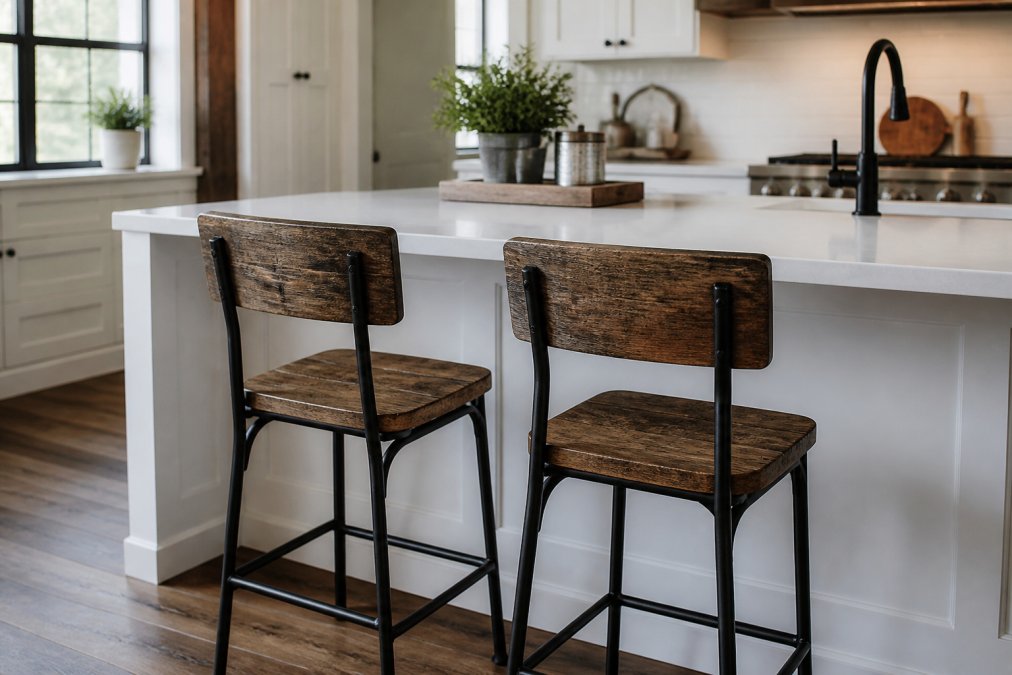
The foundational industrial design pairs a metal frame with a solid wood seat, often powder-coated black or bronze with oak, walnut, or reclaimed lumber. This reads equally well in a farmhouse kitchen or contemporary loft. For durability, look for a wood seat bolted through the frame, a matte finish, and a foot ring that is welded, not screwed. Powder-coated steel in the 16- to 14-gauge range is the residential sweet spot; anything thinner flexes, anything thicker adds unnecessary weight (ansi.org). Cast iron bases lower the center of gravity and reduce tipping on uneven floors.
Backless Stools for Tight Spaces
Backless stools tuck completely under a counter or island, making them the default for narrow kitchens or islands with seating on multiple sides. The tradeoff is ergonomic: without a backrest, your core muscles keep you upright, which becomes noticeable after thirty minutes and can lead to lower back fatigue. The fix is a foot ring positioned so your knees sit at roughly 90 degrees. For quick meals, backless options are ideal; for long dinners or home office sessions, a backed stool is better. Look for at least 16 inches of seat depth, and for households with children or older adults, a lower seat height (around 24 inches).
Swivel Mechanisms for Easy Movement
A swivel mechanism lets you rotate without scooting the stool, useful at a counter where you may need to turn to reach a fridge or speak with someone behind you. Swivel stools often include a gas-lift or adjustable height feature. The mechanism should be concealed within the seat base. Test the rotation: a smooth 360-degree turn with minimal wobble indicates a quality bearing. A swivel base introduces subtle instability that can increase lower back fatigue; if you are prone to back pain, choose a locking mechanism or a base at least 18 inches in diameter. Gas-lift mechanisms are rated by cycle count, residential units last about 50,000 cycles, commercial-grade units 200,000 or more, so for daily home bar use, a commercial-grade lift is a reasonable investment.
Upholstered Industrial Stools: Comfort Meets Utility
A growing subcategory pairs the raw metal frame with a padded, upholstered seat, often leather, vinyl, or heavy-duty woven fabric, softening the industrial look without abandoning it. Upholstery introduces a maintenance variable: leather requires periodic conditioning, vinyl can peel after a few years, and fabric should be treated with a stain guard. A padded seat, typically 2 to 3 inches of high-density foam, reduces pressure on the sit bones for anyone seated more than an hour. Since upholstery hides the seat construction, look for visible bolts or a metal bracket, not just adhesive, so the seat will not separate from the frame under load.
Adjustable-Height and Multi-Position Stools
Adjustable-height industrial stools bridge counter and bar applications, using a pneumatic gas lift housed inside the central column. Some span 24 to 32 inches, covering both heights, but the wider the range, the higher the price and the more visual bulk. An adjustable stool lets each household member set the seat height to their own leg length, avoiding the dangling-feet problem of fixed-height seating. Gas lifts can fail over time, so check whether the manufacturer sells replacement parts; a proprietary cylinder that cannot be sourced after two years makes the stool a disposable item.
Reclaimed Wood Bar Stools: Character That Lasts
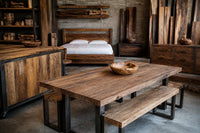
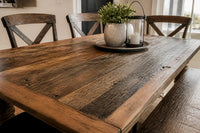
Reclaimed wood bar stools offer a visible history no factory-made piece can replicate. Each board carries nail holes, saw marks, and patina, making every stool one-of-a-kind. We source much of our material from barns, and the wood's structural integrity testifies to old-growth timber. Reusing this material keeps it out of landfills and avoids felling new trees.
When evaluating reclaimed wood seating, ask about the source and preparation. Wood that is properly kiln-dried and milled resists cracking and warping in a heated home. A hand-rubbed oil or low-sheen sealant protects the surface without hiding the grain.
Bar Stool Height Guide: Counter vs. Bar Height
Choosing the wrong height is the most common mistake in buying industrial seating, and it is avoidable with one measurement. Counter height stools (24 to 26 inches) pair with 36-inch counters; bar height stools (29 to 31 inches) pair with 42-inch bar tables. Leave 9 to 12 inches between the seat cushion and the underside of the counter for leg room.
Measure your counter first, then shop for the stool. Most manufacturers list the seat height clearly, though some offer adjustable models that span both ranges. An adjustable gas-lift mechanism adds cost but removes guesswork, especially in a home where the same stool might move between a kitchen island and a basement bar. For a visual reference, the American National Standards Institute guidelines on seating dimensions provide baseline ergonomic data used across the furniture industry.
| Counter Type | Standard Height | Recommended Stool Seat Height |
|---|---|---|
| Standard Kitchen Counter | 36 inches | 24-26 inches |
| Bar Height / Raised Counter | 42 inches | 29-31 inches |
| Extra Tall Bar | 45+ inches | 33+ inches (or adjustable) |
Custom Industrial Bar Stools for Commercial Spaces
Custom industrial bar stools are the standard for restaurants, breweries, and cafes that want seating to reinforce a brand's visual identity. Off-the-shelf options look generic and rarely survive daily commercial use. At Strong Oaks Woodshop, we work with owners to design seating that matches their interior, from stain color to metal finish, with heavy-duty construction, thicker gauge steel, reinforced welds, and seats built for continuous use.
The lead time for custom work is longer than buying retail, but the result is furniture that defines the room rather than merely filling it. When commissioning custom pieces, specify the seat height, the weight capacity you need, and whether the stool will be used indoors or on a covered patio. Guidance on commercial furniture durability standards can help you understand the testing protocols that separate residential seating from commercial-grade builds. Many owners also choose a slight customization in the upholstery, opting for leather seating or a durable fabric that matches the bar's palette.
Safety, Durability, and Weight Capacity
Industrial stools look tough, but not all are built to the same standard. Weight capacity is the clearest indicator of construction quality: a residential stool might be rated for 250 to 300 pounds, while a commercial-grade piece can handle 500 or more. The difference comes down to thicker steel, more weld points, and a wider base. But weight capacity alone is not the full safety picture, stability, tip-over resistance, and finish durability matter just as much.
Understanding the Standards Behind the Rating
The U.S. furniture industry relies on voluntary consensus standards from ASTM International, ASTM F2613 for non-upholstered stools and ASTM E1561 for commercial seating, defining test methods for stability, load-bearing, and fatigue. A stool passing ASTM F2613 has undergone a static load test (typically 1.5 times rated capacity) and a stability test with off-center loads. For commercial applications, BIFMA X5.1 includes a cyclical fatigue test simulating years of daily use. If a listing does not explicitly cite ASTM or BIFMA standards, the weight rating is a marketing claim, not a tested specification.
Tip-Over Risk and Base Geometry
Tip-over accidents are the most common furniture-related injury in American homes. The risk is highest when a child climbs onto the seat or an adult leans back beyond the base footprint. The wider the base and the lower the center of gravity, the harder it is to tip, a 16-inch base is significantly more stable than a 12-inch one. Look for legs that splay outward slightly, and check floor contact points: rubber or felt feet increase friction and resist sliding, while smooth metal feet on tile are a slip hazard.
Weld Quality and Joint Integrity
The frame's strength lives in its welds, not its tubing. Inspect the weld points where legs meet the seat ring and where the foot ring attaches. A quality weld is continuous, smooth, and free of pitting; a spot weld is a red flag for residential use. For commercial applications, welds should be ground smooth and inspected for porosity. If welds are hidden, ask the manufacturer for a photo of the bare frame, a reputable maker will provide it.
Finish Durability and Corrosion Resistance
Industrial stools face moisture, food splatter, and cleaning chemicals, so the finish is your first line of defense. Powder coating is the industry standard, thicker and more chip-resistant than liquid paint, while cheaper spray-on enamel chips easily, exposing steel to rust. For reclaimed wood seats, a penetrating oil like tung or hardwax oil protects without building a plastic-like film; polyurethane offers more protection but obscures the grain. For a covered patio or humid environment, specify a marine-grade finish or stainless steel frame.
Weight Capacity: What the Number Really Means
A weight rating is a structural limit, exceeding it can crack a weld or buckle a leg. Size for the heaviest regular user, not the average, and add a 20 percent safety margin for dynamic loading when someone sits down quickly. A stool rated for 300 pounds is adequate for a 250-pound adult who sits down normally, but marginal for one who drops onto the seat. Commercial-grade stools rated for 500 pounds offer a larger safety margin and longer service life; the tradeoff is weight and a bulkier look.
Conclusion: Find Your Perfect Industrial Stool
The best industrial style bar stool designs balance three factors: the visual character of the materials, the ergonomics of height and backrest, and the durability required for your setting. A reclaimed wood seat on a powder-coated steel frame delivers the raw aesthetic most people picture, while a swivel or adjustable height adds practical comfort. For commercial spaces, prioritize heavy-duty construction and a custom design that matches your brand.
At Strong Oaks Woodshop, each stool is hand-built from authentic reclaimed wood in America, with customizable dimensions and finishes for residential and commercial clients. Our process includes on-time shipping and direct communication throughout the build. Whether you need one statement stool for a kitchen island or a full run for a restaurant bar, we design pieces that hold up to daily use and look better as they age.
Frequently Asked Questions
What defines industrial style bar stool designs?
Industrial bar stools combine raw materials like reclaimed wood, cast iron, and steel with a functional, minimalist aesthetic. Look for matte finishes, exposed hardware, and vintage-inspired details. These designs prioritize structural integrity and often feature foot rings or protective feet. The result is a sturdy piece that brings a raw aesthetic to your kitchen or bar area.
How do I choose the right height for industrial bar stools?
Use our bar stool height guide: for a standard 36-inch counter, choose stools around 24 to 26 inches tall. For a 42-inch bar, pick stools that are 29 to 30 inches high. Measure from the floor to the underside of your countertop and leave 9 to 12 inches of clearance between the seat and the counter for comfortable legroom.
Are industrial bar stools comfortable for daily use?
Comfort depends on the design. Backless stools are space-saving but less supportive for extended sitting. Look for models with a foot ring and a slightly contoured seat. For daily use, consider a bar stool with a backrest or an upholstered seat in leather or fabric. Ergonomic design matters more than the industrial aesthetic.
Can industrial bar stools work in a modern farmhouse kitchen?
Yes. Reclaimed wood bar stools pair naturally with modern farmhouse style. Choose stools with a lighter wood finish and a black powder-coated metal frame to blend both aesthetics. The rustic charm of the wood softens the industrial metal, creating a warm, inviting look that complements shaker cabinets and butcher block countertops.
Where can you buy custom industrial bar stools?
Strong Oaks Woodshop builds custom industrial bar stools from authentic reclaimed wood. Each piece is hand-built to your specifications, so you can choose the height, finish, and dimensions that fit your space. This is ideal for odd-shaped kitchens or commercial settings where standard retail sizes do not work. Visit the website to discuss your project.
Finding the right stool comes down to measuring your space, choosing a height, and deciding how much character you want the wood to carry. Strong Oaks Woodshop builds custom industrial bar stools that fit your exact dimensions, with hand-finished reclaimed wood and commercial-grade frames. Get started with Strong Oaks Woodshop and bring a one-of-a-kind piece to your home or business.